
1.jpg)
Table of Contents
Buy/Sell Your Unlisted Shares
Submit the details below to share a quote.
TL;DR
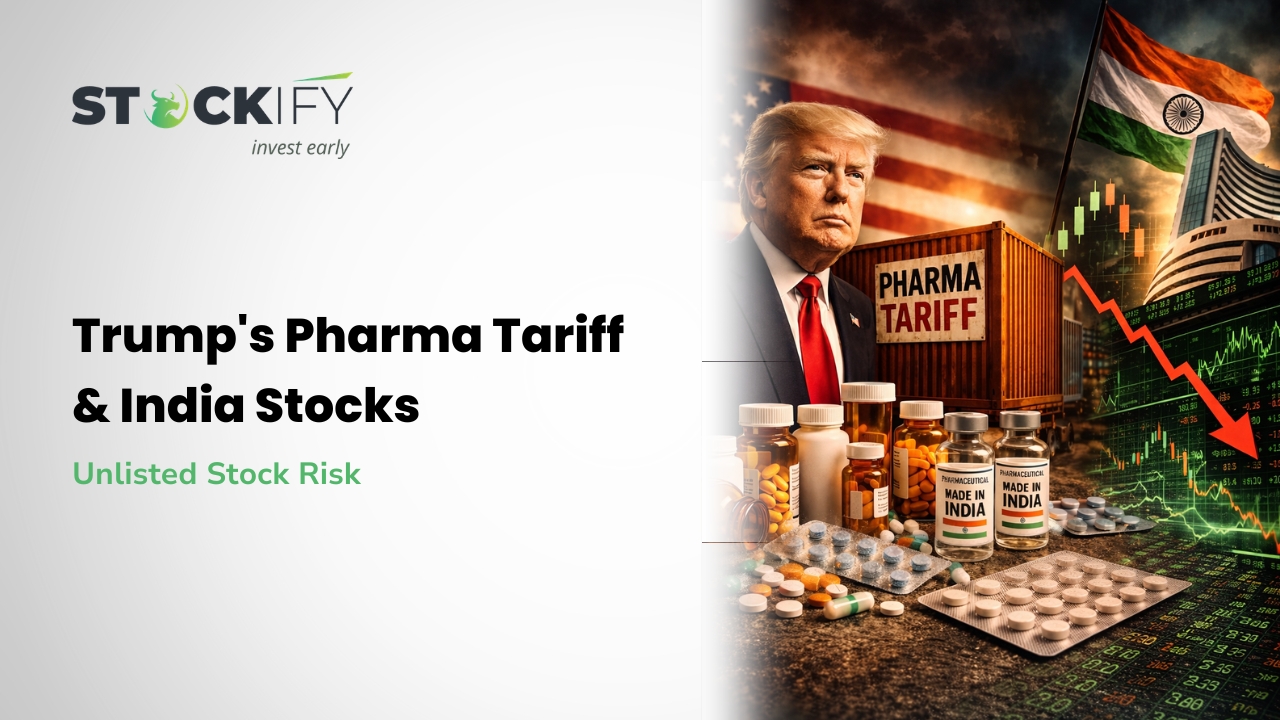
President Trump imposed a 100% tariff on branded and patented drugs entering the US effective from October 2025.
Generic medicines are exempt but that exemption may not last.
The stakes are enormous because India supplies 40% of US generic medicines.
The Nifty Pharma Index fell 3.8% after the tariff imposition.
Unlisted Stocks-Hidden Risks and Opportunities
Section 232 and how India is responding.
Introduction
The impact of US President Trump’s decision to lay 100% tariff on patented pharmaceuticals does not look to completely blow the market for India.
India supplies nearly 40% of all generic medicines consumed in the United States. For decades, this has been the major cornerstone of the health economies of both the countries. But with the Trump tariff on Pharma, the relationship between the two countries looks to be strained. For investors tracking India’s unlisted and pre-IPO pharma stocks, the implications are deep, urgent and complex.
Let us read ahead to see what does the tariff actually cover, what will be the risk for the unlisted pharma companies, and where should the smart investors look at the moment.
What is Trump’s 100% Pharma Tariff?
Trump tariff on pharma at 100% clarifies crucially that the generic drugs, a segment in which the Indian companies dominate globally are under exempt “in present”. It further adds that such products shall not be subject to section 232 tariff.
The current exclusion of generics provides a critical buffer, safeguarding the continuity of low-cost medicines exports that underpin India’s pharmaceutical trade relationships with the United States.
The key provisions of the Trump Tariff on Pharma include:
100% tariff on branded/patented drugs, effective from October 1, 2025.
Generic medicines are currently exempt-but this exemption is not permanent.
Companies that commit to building or expanding manufacturing plants on US soil qualify for an exemption from the tariff.
A section 232 national security investigation into broader pharmaceutical imports is underway, which could eventually pull generics into the tariff net as well.
The announcement sent shockwaves across global pharma markets.
India’s Footprint in the US-A Quality Reality Check
You need to understand how deeply Indian pharma is embedded in the American Healthcare System
Indian has the largest number of US FDA approved manufacturing plants outside of America itself.
Indian generic medicines save the US healthcare systems $219 billion in 2022 alone.
India along with Ireland, Singapore, and Switzerland, is among the countries with which the US runs its largest pharma trade deficits. (Source: Spherical Insights)
This is a structural dependency and not a peripheral trade relationship. And this is precisely why the Trump Tariff on Pharma has caused such intense concern among Indian pharmaceutical companies and policymakers alike.
Yet, the situation is new because generic is exempted, not all Indian pharma companies are exposed. The real question, especially for investors in unlisted stocks, is who sits on which side of that line.
Impact on Listed Vs Unlisted Pharma Stocks
Listed Stocks -Immediate Reaction
The Indian stock market responded swiftly and sharply, within a few hours of the tariff announcement.
The Nifty Pharma index fell up to 3.8% (Source: NDTV Profit)
Sun Pharma was identified as the most vulnerable large cap, given it earns maximum from US revenue from speciality and branded drugs.
Biocon dropped ~5% while Glenmark, Sun Pharma, Aurobindo, and IPCA Labs fell more than 4%.
Some companies like Biocon, Cipla, Dr Reddy’s, and Lupin are considered more protected.
Now let us look at the unlisted IPO Pharma stocks.
Unlisted/Pre-IPO Pharma Stocks-The Hidden Risk and Opportunity
The impact on unlisted pharma stocks is less visible but equally significant. Unlike listed companies where prices adjust instantly, valuations of unlisted stocks take longer to reflect macro shocks, creating both a risk and an opportunity for informed investors.
Here is how different types of unlisted pharma players are affected:
Companies at higher risk:
Unlisted pharma firms with a US-facing brand are more likely to face direct tariff exposure once they go public or scale exports.
The companies that are planning US IPOs or US market entry may face delayed timelines.
Firms that have been valued on the basis of the US market potential may see grey market premiums erode.
Companies with opportunity:
Active Pharmaceutical Ingredient manufacturers supplying US-based generic drug companies could benefit as those companies seek tariff exempt supply chains.
Contract Development and Manufacturing Organisation players may see increasing demand as US pharma firms look to restructure their manufacturing partnerships.
Will Generics Stay Safe? The Section 232 Threat
The section 232 outcome is the biggest policy risk to watch in 2026. If generics were tariffed, this is what will happen:
Generic drug manufacturing operates on very thin margins often 5-15%
Industry had already warned that a tariff above 10% would also make high-volume generic production economically unviable for Indian exporters.
The Indian pharma exports revenue account at over $27billion in FY 2024-25. Now a 100% tariff on generics would be a catastrophe in such a situation.
Strategic Responses Indian Pharma Companies are Taking
The Indian pharma industry is not waiting passively. This is how they are getting prepared:
Large listed companies like Cipla, Biocon and others are actively building US manufacturing facilities, positioning themselves for tariff exemption.
Several mid-cap companies are evaluating US capex investment to qualify for the exemption clause.
Some companies are accelerating plans to diversify in Europe, Southeast Asian markets, and African countries to reduce US revenue dependency.
Final Thoughts
The market will run and continue to operate how market conditions change after the Trump tariff on pharma. At the moment the investors must prefer to stay away from generic exporters who have no revenue diversification outside the US. But they must closely watch unlisted companies who announce any US plant investment or JVs because they may qualify for tariff exemption soon.
FAQs
What do you mean by the 100% Trump tariff on Pharma?
It implies 100% import duty imposed on branded and patented drugs entering the US effective from October 2025.
Why did Trump levy a 100% tariff on pharma?
The idea is to bring back manufacturing back to American soil and reduce dependence on foreign pharma suppliers.
Which Indian companies are most at risk after Trump's 100% tariff on Pharma?
Sun Pharma is most exposed and companies like Cipla and Lupin who have existing US manufacturing operations are less exposed.
What is Section 232 pharma investigation?
It is the section to check all the drugs that enter the US deemed as national security threat.
You may also like to read
What Are The Different Classes Of Shares Issued In India?
Different Classes of Assets In The Financial Market

Follow These Simple Share Market Tips While Investing
Importance of Investing in Unlisted Shares

Step-by-step Process Of Transferring Unlisted Shares (Off-market)

Pre IPO Success Stories To Start Your Unlisted Share Trading

What Is The Expected Return Of Unlisted Shares?
A Detailed Guide On How To Buy Unlisted Shares In India
Know Your Tax Implications Before Investing In Unlisted Shares
Common Mistakes To Avoid While Investing In Unlisted Shares
How To Pick Best Performing Unlisted Stocks in India?
Risks And Rewards Associated With Unlisted Share Investment
Difference Between Start-Up Investing And Unlisted Shares?
IPO Process in India: Key Steps Explained Clearly
Revealed: The Real Picture of Unlisted Shares in Grey Market
Key Financial Ratios And How To Use Them To Analyse Your Investment

101 Guide For Beginners: What Is Pre IPO Share Market?
10 Golden Rules Of Investing In Stock Market
Listed Shares Vs. Unlisted Shares - Detailed Comparison
The Dark Side of Paytm's IPO Explained In Details

What Leads to Delisting of Shares and What Goes Behind The Scenes?

When Should You Review Your Portfolio Professionally?

In-Depth Analysis of Pre-IPO Shares for Portfolio Growth
PharmEasy Unlisted Price Falls 70%. Here's why
Delaying Pre-IPO Investments? Here’s What You Risk

An NRI’s Guide To Invest In Unlisted Shares In India
Guide To Filter The Most Profitable Unlisted Companies In India
A Comprehensive Guide On Follow-on Stocks

Care Health Insurance

Smart Strategy to Buy & Sell Unlisted Shares Professionally
Top Highly Profitable Unlisted Companies In India To Look For As An Investor

Upcoming IPOs In 2022-2023
Expert’s Driven Roadmap To Research A Startup IPO
Capgemini Unlisted Shares: Is The Risk Worth?

HDFC Sec vs HDB Financial: Which Is the Better Pick?

Detailed Guide To Calculate Capital Gains on Unlisted Shares
Dematerialisation of Unlisted Shares and Its Impact On Shareholders
How are B9 Beverages Pvt Ltd (Bira91) Unlisted Shares Gaining Pace Again?

Reliance Retail: The Success Story of India's Largest Retail Brand

The Future Of Unlisted Shares In the Fintech Market
Employee Stock Ownership Plan: What, How, and Why?

Studds Unlisted Shares: 6 Reasons to Buy Now

LAVA’s Unlisted Shares Soar Under Atmanirbhar Push
NSE vs BSE: Detailed 101 Market Share Comparison

The Role Of Corporate Governance And Management In Unlisted Companies
What's Temperature Ahead Of Tata Technologies' ₹4,000 Cr. IPO?
The Future Outlook For Unlisted Shares As An Investment Option

How to Buy and Sell Unlisted Shares in India?
The Benefits And Drawbacks Of Investing In Unlisted Shares